Showing posts with label real estate investment ebook. Show all posts

Sunday, August 15, 2010


The foreclosure process is not very difficult to understand. There are several stages during which the homeowner has an opportunity to bring the loan current and avoid foreclosure.

After about three to six months of missed payments, the lender orders a trustee to record a Notice of Default at the County Recorder's Office. This puts the borrower on notice that he is facing foreclosure and starts a reinstatement period that typically runs until five days before the home is auctioned off.

If the default isn't corrected (the loan must be brought current) within three months, a foreclosure sale date is established. The homeowner will receive a Notice of Sale, and this notice will also be posted on the property. In addition, the Notice of Sale is recorded at the County Recorder's Office in the county where the property is located. Finally, this Notice of Sale is also published in newspapers local to the county in question over a three-week period.

The foreclosure Trustee Sale typically occurs on the steps of the county courthouse in which the property is located. The time and location of this sale are designated in the Notice of Sale. At the Trustee Sale, the property is auctioned in public to the highest bidder, who must pay the high bid price in cash, typically with a deposit up front and the remainder within 24 hours. The winner of the auction will then receive the trustee’s deed to the property.

Foreclosure Auction
At auction, an opening bid on the property is set by the foreclosing lender. This opening bid is usually equal to the outstanding loan balance, interest accrued, and any additional fees and attorney fees associated with the Trustee Sale. If there are no bids higher than the opening bid, the property will be purchased by the attorney conducting the sale, for the lender.

If this occurs, and the opening bid is not met, the property is deemed a REO or Real Estate Owned. This typically occurs because many of the properties up for sale at foreclosure auctions are worth less than the total amount owed to the bank or lender.

When you purchase property at a foreclosure sale, all junior liens other than property taxes are wiped out. Priority of liens is determined by the date of recording. When you purchase a Bank REO, you will typically receive the property with a clean title.


For more insightful information into the foreclosure process read our new ebook at
www.howtomakeakillinginrealestate.com

How to Select a Real Estate Agent to Buy a Home


Ask friends for referrals. Friends can give you a starting point, but don't hire an agent solely on a friend's recommendation. Don't choose an agent based on personality alone, but make sure you can get along well.

Choose the broker or real estate agency first, then ask the agency to recommend a couple of their best agents. Then stick with her. If you see a house for sale and call the agent listed on the sign, that agent's first concern will be representing the seller, not you, the buyer. "Sometimes the broker is associated with a franchise, such as Century 21. "If you select a franchised broker, you have the advantage of national name recognition and usually a strong national advertising campaign." But beware. "You aren't guaranteed a great agent just because you selected a well-known real estate franchise. You should select a firm based on that office's reputation -- not the reputation of the national firm."

Consider choosing an agent who is a Realtor. In addition to being licensed by the state to sell real estate, Realtors belong to the National Association of Realtors and must abide by a strict Code of Ethics. The National Association of Realtors has a code of ethics that will knock your socks off, and they are very strict in dealing with people who don't abide by them. Also, only Realtors have access to Multiple Listing Services (MLS) through which members share listings and have access to many more properties than non-members. You can locate a Realtor in your area at www.realtor.com.

Avoid "dual agencies." These are agencies that represent both the buyer and the seller. The same person cannot equally represent both the buyer and the seller.

Choose an agent that handles homes in your price range. Some agents specialize in high-end properties and won't give their best effort on properties under a set value. If they usually deal in fixer-uppers, they won't have the experience to navigate "Millionaire's Row".

Choose an agent who listens to your needs and takes the time to explain things you might not understand. Real estate transactions can be complicated and the terminology confusing. You need an agent who will both know the answers to your questions and takes the time to explain them. It's extremely important to find an agent whose personality you like, whose firm helps people find professional, trustworthy agents. "You want them to be bright, professional, trained, and someone who works in the business full-time, but personality is important. You're going to spend a lot of time with this person whether you are buying or selling. If you hate the agent and the agent hates you, you may be too far along in the process to correct it."

Choose an agent who works on your time schedule. If you can only look at homes on Sundays and your agent doesn't work that day, look elsewhere. If a listing agent doesn't work on weekends, consider who will be responsible for showing the house on weekends or holding open house. When buying a house, your agent will set up appointments for you to tour different homes and will accompany you on the tour. You should ask your agent a lot of questions; after all, she is the expert. Ask her opinion of the home.

Choose an agent who can and will provide other services. Will they help arrange a house inspection, refer you to qualified lending professionals and real estate attorneys, and conduct a study of the property's value?


Need more hard hitting advice then check out the latest Ebook from Al Yusra, "How to Make a Killing in the Real Estate Market."

Friday, August 13, 2010

Buying a House for Cash


Chapter 2: Buying a House for Cash

The adage reads, “Buy low and sell high” and nothing could be truer in the 2010 real estate market. With single family homes selling below $20,000 the opportunities to make money are endless. The key is finding the right property in the right area and managing it properly. You learn more from your mistakes than you do from your successes, so it is important not to make the same mistake twice.

The key to buying an investment lies in cash. Cash is king and 30-year and 15-year mortgages are not king they are debt and the only instant profit you can earn from them is reducing your debt unless of course you sell the property for higher than the outstanding mortgage balance.

To top that off, getting into debt and paying interest goes against many religious precepts. The three main religions in the United States, Christianity, Islam, and Judaism all speak against charging usury (interest) in their religious books.

In the Bible it states in Leviticus 25:35-37: "If one of your brethren becomes poor, and falls into poverty among you, then you shall help him, like a stranger or a sojourner, that he may live with you. Take no usury or interest from him; but fear your God, that your brother may live with you. You shall not lend him your money for usury, nor lend him your food for profit."

In the Qur’an it states in Chapter 2 verse 275 - 279 (Baqarah), “Those who consume interest cannot stand [on the Day of Resurrection] except as one stands who is being beaten by Satan into insanity. That is because they say, "Trade is [just] like interest." But Allah has permitted trade and has forbidden interest. So whoever has received an admonition from his Lord and desists may have what is past, and his affair rests with Allah. But whoever returns to [dealing in interest or usury] - those are the companions of the Fire; they will abide eternally therein...”

The Talmud references Ezekiel 13 (Hebrew.): "He has lent on usury; he has taken interest; he shall surely not live, having done all these abominations."


With the admonition from the religious sector along with what reality shows us, buying houses with interest and paying a bank interest is like building a house with sticks and no foundation, when a big storm comes the whole thing falls apart.

While there are riches made every day by people who buy real estate with no money down and a totally financed mortgage by the bank, there is a lot of risk inherent in this practice. All we have to do is look at the crisis now with the banks closing down, foreclosure rising, homelessness, and unemployment and we can see the result of usury based economics. According to the Federal Deposit Insurance Corporation (FDIC), twenty-three banks failed in July 2010 in the United States.

Debt and plentiful credit has powered the United States economy for decades. But since the financial crisis of 2008, America has gone on a drastic debt diet. Families are paying down credit-card debt and attempting to build up cash reserves. Large and small businesses are learning to operate in an environment where cash once again is king.

The economic shift has been dramatic; bank lending has dropped at a frightening rate. In 2009 the banking system showed the largest decline in loans in the history of the FDIC. At the same time, the amount of commercial and industrial loans outstanding has fallen 19 percent since the fall of 2008—back to the level of late 2006. Even the financial sector, which shoveled debt into the economy like there was no tomorrow have seriously cut back on debt.

During the last two decades people spent and invested based on expectations of what they could borrow. But now things have changed and cash is making a come back. What better time and opportunity then to throw money to the winds and invest in a house with cash and avoid the mortgage trap.

I know it’s hard and you want your interest deduction write off on your taxes and like the regularity of making that monthly mortgage payment. But what about the freedom to lose your job and not have to worry about losing your house in the next month because you fear you will fall behind in your mortgage. There is something to be said for financial security after all. I know I enjoy it with six children between the ages of 2 and 13 and a husband who likes to travel to Europe three or four times a year.

You may wonder, how can I buy a house for cash. Well if you live in Fairfax, Virginia, or any of the other big money enclaves then it will be hard to buy a house for cash in that area, but there are other areas in Virginia where this is possible.

There are numerous areas around the country where you can find single family homes listed at prices under $20,000 with some going as low as $1000. Some of the distressed areas of the United States where you can get real bargains include Detroit, Michigan, Indianapolis, Indiana, Baltimore, Maryland, Memphis, Tennessee, Miami, Florida, Orlando, Florida, Atlanta, Georgia, and Cleveland Ohio.


Check Out the Newly Released Ebook at www.howtomakeakillinginrealestate.com
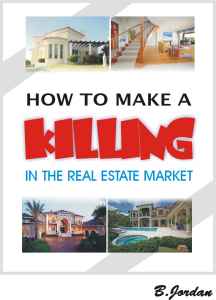
Preview of Chapter 1: Overview of How to Make a Killing in Real Estate

Chapter 1: Introduction

Real estate is one of the greatest wealth building tools in the world. Unfortunately, many people think that building wealth is tied to how much money they can borrow and how large a mortgage they can attain. Well after the real estate and bank crash the reality should now be settling in that all that glitters is not gold. True wealth is not built by accumulating houses through debt or by the number of platinum credit cards in your wallet.

A prime example of this is Donald Trump, a multi-millionaire who has filed numerous corporate Chapter 11 bankruptcies with his real estate empire. Even though he still has his own television show and is well respected in the business arena he is proof that buying things on credit is not always beneficial in the long run.

True wealth means having no debt and at least twenty-four months living expenses stashed away in cash savings. This means your cars are paid for, your house is paid for, and you have no credit card balance that rolls over month after month. True wealth is not tied to your FICA score. It means that if you lose your job, you don’t have to worry because your house is paid for and you have other investment income that is bringing in money. Your wealth is not tied to your job or your car, or your spouse as all of those things can change.

This e-book will teach you everything that you need to know about buying a real estate property and making a profit in the first year, doubling your investment in the second year, and eventually selling it when the market rebounds.

This book is meant to be an educational tool to get out of the poverty trap and into true wealth. In this book you will learn from my mistakes as a real estate investor and benefit from the things that I learned as an average woman with very little disposable income.

When you have real wealth you can choose when you want to work and if you want to work. You can decide to stay home and see the kids through their growing years or sit back and take the winter off and travel to the Caribbean, Dubai, or Europe. The world is your oyster when you have nothing to tie you down.

The real estate market represents a prime wealth building situation that everyone should take advantage of but you must do your homework and you must know when to hold them, when to walk away and when to run! I have learned all of these things and I want to share them with you. This information is not something that you will hear on the radio as most people want you to be in debt and stay in debt. Most people will teach you how to have good credit and keep good credit and how to qualify for the house you really can’t afford.


Not many people will recommend buying a house for cash or if they do it may seem insurmountable especially when you are barely making ends meet, but it can be done.

There are pockets of areas throughout the United States where you are able to purchase real estate for under $40,000 in decent neighborhoods. One area that we have researched extensively is the metro Atlanta area. This area is unique in that it has sales in some areas of Atlanta as low as $7000 and as high as $10,000,000 making it difficult to establish an average.

We have also researched the Orlando Florida area with its rich resources and favored city status it is a prime choice for investors. In Orlando you can find property that was purchased for $160,000 in 2008 now listed at $22,900 in 2010.
In Chapter nine, there is a case study on the Orlando Florida real estate goldmine with step-by-step instructions on finding property goldmines.

Real estate investment has produced more millionaires than any other industry and it has proven to be a genuine wealth builder for centuries as well as a wealth destroyer. How many a fine investor has bought a house with a mortgage and then lost his job and was unable to pay? He was just two weeks notice away from bankruptcy and poverty. Well that does not have to be you. Real estate investment is a long term investment and while it is possible to buy a house for $20,000 and renovate and sell it for $100,000 this usually takes time. This type of return does not happen every day, but if you select the right type of property in the right area this can happen. I have seen it happen more times than I care to mention and in this market it can happen in less than two years.

Rental income can also be very lucrative if you know how to get solid tenants and keep good tenants. I learned the hard way how to tell when a tenant is lying and will give you the secrets to the trade and make sure you don’t get duped. Real estate investing can be the path to financial freedom but it is not easy it takes perseverance, education, and hard work. This book is an eye opener so sit down, relax, and take notes.